Wake For Wifi Network Access Mac
From the Macbook Pro to the light Macbook Air, Apple’s laptops have become a popular device for many business users. As with all other laptops, these devices can run on battery power and being able to conserve this is worth knowing about.
Waking your Mac requires: The 'Wake for network administrator access' option must be enabled in System Preferences -> Energy Saver. It may be called “Wake for network access” or “Wake for Ethernet network access.”. About Wake on Demand No. It's not just a matter of keeping WiFi on. The app that you use to download will not run if your Mac is sleeping. Caffeine can temporarily override your Energy Saver settings and prevent your Mac from sleeping, if you leave the lid open.
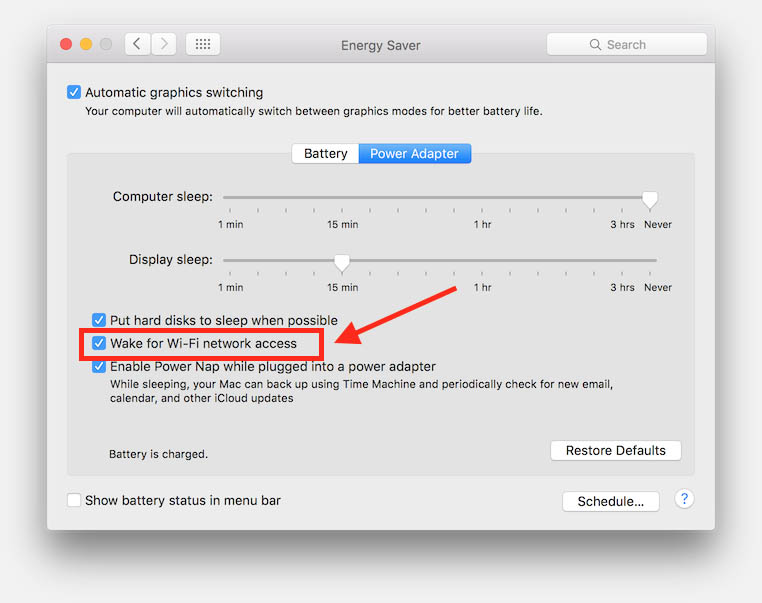
In fact, with all Apple computers there is an energy management feature that could prove useful in configuring how much power is used. What is Energy Saver for Mac? Energy Saver is a feature included in all versions of OS X after version 10.6 (Snow Leopard) that allows users to configure how their computer users energy – both when running on battery and when plugged in. All Apple computers have this feature, including desktop computers, but it is most useful for those with laptops, where you can configure your laptop to extend battery life. Accessing Energy Saver preferences There are two ways you can access the Energy Saver function on your Mac. If you are using a laptop, you should see a battery icon in the top menu bar of the screen, usually located on the right. Press this and select Open Energy Saver Preferences If you don’t see the battery icon at the top of your screen, or are using a desktop, then press Command + Spacebar to open Spotlight.
Now you can insert or delete rows and columns without any tension. 4- press Save button. 5- close your file. 6- then open the saved file. How many columns in excel.
Type Energy Saver in the bar that opens at the top of the screen and click on Energy Saver from the drop-down search results. Looking at the Energy Saver preferences Depending on the type of Mac you are using – laptop or desktop – you should see up to three tabs – modes of power – at the top of the screen: • Battery • Power Adapter • UPS (Uninterruptable Power Supply) Clicking on any of the tabs will bring up power settings related to that particular power source.
Configuring energy use while on Battery When you click the Battery tab you should see the following options come up (on OS X Mavericks and later.) • Turn display off after: This is a slider bar that allows you to set how long the computer needs to be inactive (no buttons clicked, or user interaction) before the display is turned off. When you are operating off the battery, it is a good idea to set this lower so that the display – which draws power – will be turned off quicker, saving more power. Canboscab lide 220 driver for mac. • Put hard disks to sleep when possible: When ticked, the hard disks will be put to sleep when the system isn’t being used, or they are not needed.
• Slightly dim the display while on battery power: Will lower the brightness of the screen when the power cord is unplugged in order to save more energy. • Enable Power Nap while on battery power: Power Nap is a feature that allows the computer to wake up every now and then in order to check for software updates. It is a good idea to turn this function off if you are worried about saving battery life, instead checking for updates when the computer is awake. Configuring energy use while on Power Adapter When you click on the Power Adapter tab you should see the following options: • Turn display off after: This is a slider which allows you to set when the display will turn off, after there has been no activity for a set period of time.