Can You Use Macros In Excel For Mac
Macros—automated actions or sets of actions in Excel—can spare you some of the tedium associated with repetitious command sequences and data manipulation tasks. In this course, learn how to create and use macros to automate tasks in Excel 2016 for Mac.
Excel for Office 365 for Mac Excel 2019 for Mac Excel 2016 for Mac To automate a repetitive task so that you can do the task again with a single click, you can use the Developer tab in Excel for Mac to record and run a macro. You can also create a macro by using the Visual Basic Editor in Microsoft Visual Basic for Applications (VBA) to write your own macro programming code. If you no longer use a macro, you can delete it. Record a macro When you record a macro, the macro recorder records all the steps required to complete the actions that you want your macro to perform. These steps can include typing text or numbers, clicking cells or commands on the ribbon or on menus, formatting, selecting cells, rows, or columns, and dragging your mouse to select cells on your spreadsheet. The commands for recording, creating, and deleting macros are available on the Developer tab on the Ribbon.
• If the Developer tab is not available, do the following to display it: • Select Excel > Preferences > Ribbon & Toolbar. • Under Customize the Ribbon, select Main Tabs and then check Developer. • Click Save and then close Excel Preferences.
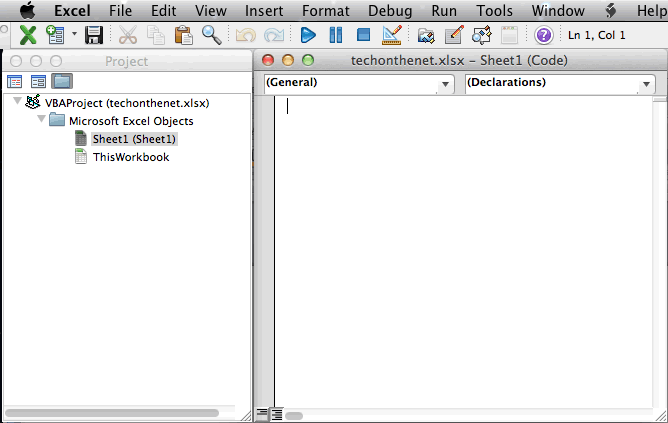
• On the Developer tab, click Record Macro. Note: To create a macro from VBE, click Visual Basic. Free download winrar software for windows 7. In the code window of the module, type the macro code that you want to use. • In the Macro name box, enter a name for the macro. The first character of the macro name must be a letter. Subsequent characters can be letters, numbers, or underscore characters.
Spaces cannot be used in a macro name; an underscore character works well as a word separator. If you use a macro name that is also a cell reference, you may get an error message that the macro name is not valid. • In the Store macro in list, select This Workbook. • In the Shortcut key box, type any lowercase letter or uppercase letter that you want to use.
I have a HUGE Excel VBA Macro that was written under Windows. It reads in a CSV file, changes the content, then writes out a new CSV. Sometimes it reads in.JPG files just to check if they exist. No databases. NOW I want to run it on a Mac using 'Excel for Mac' under OS/X, and not using Parallels, VMware, etc.
SOOOOOO does anybody know what is needed to convert Excel VBA from Windows to MAc/OSX? Offhand the only change I can think of is to change all the 'C:' to 'Macintosh HD' but I am SURE there is more to it. OR is the a Converter, or does Excel MAC know how to open & use Macros from an Excel WINDOWS?
-------------------------- ---------- ---------- ---------- ---------- - Note: Orig Excel VBA/Macro written for Windows XP and Microsoft Office 2000 But runs on most Excel versions. Mac has Excel for Mac 2008 but will upgrade if needed. As you do not want any VM or Parallels I think of only the below steps. Apple's spreadsheet application, Numbers, can't read macros that are written in VBA. Consider, * Use AppleScript to create your spreadsheet macros. This is the built-in Mac OS X scripting language.
All iWork '09 applications, including Numbers, support the use of AppleScript. * Switch to using the previous version of Excel for Mac. Excel 2004 supports the use of VBA macros. * Convert your Numbers '09 spreadsheet to a Windows Excel spreadsheet format. Open your Numbers spreadsheet, and click 'File,' then 'Save As.'
Select 'Save copy as,' and choose Excel Document from the pop-up menu. You can now apply macros to the spreadsheet by opening the spreadsheet with a Windows version of Excel.