Trust Center In Excel For Mac
Excel 2016 for Mac PowerPoint 2016 for Mac Word 2016 for Mac Word for Mac 2011 Excel for Mac 2011 PowerPoint for Mac 2011 More. Less To help prevent macros that contain viruses from contaminating your system, by default Office for Mac displays a warning message whenever you try to open a document that contains a macro. If you enable macros in Excel through the Trust Center, those settings become the new default and apply globally. If you want to enable macros for only certain.
By Macro security is a key feature in Excel. The reason is that VBA is a powerful language — so powerful that it’s possible to create a macro that can do serious damage to your computer. A macro can delete files, send information to other computers, and even destroy Windows so that you can’t even start your system. The macro security features introduced in Excel 2007 were created to help prevent these types of problems. Check out the Macro Settings section of the Trust Center dialog box. To display this dialog box, choose Developer → Code → Macro Security. Excel’s warning that the workbook just opened contains macros.
You see this warning if the VBE is not open. Excel will remember if you’ve designated a workbook to be safe. So the next time you open it, you won’t see the Security Warning. Perhaps the best way to handle macro security is to designate one or more folders as trusted locations.
All the workbooks in a trusted location are opened without a macro warning. You designate trusted folders in the Trusted Locations section of the Trust Center dialog box. If you want to find out what the other macro security settings imply, press F1 while the Macro Settings section of the Trust Center dialog box is in view. You’ll get a Help screen that describes the security settings.
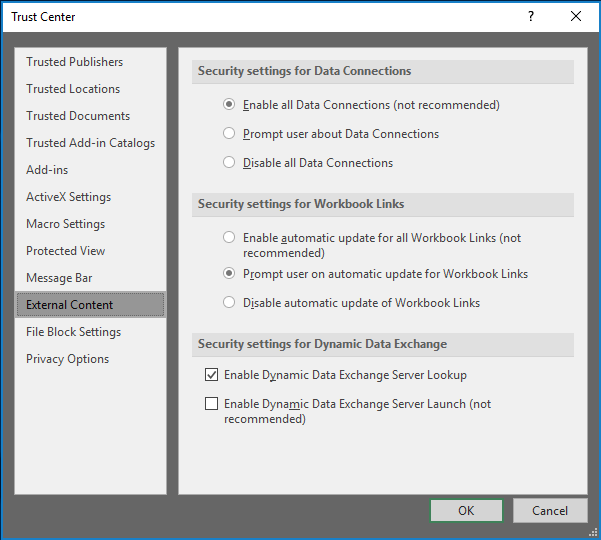
If you are using On Menus tab, click Tools menu to bring up the drop-down menu. And you can easily see the Trust Center command at the bottom from the Tools drop-down menu. See Fig.1: Fig.1 Click Trust Center, there will appear the Trust Center window, where you can make the security and privacy setting for your outlook 2010/2013, such as Trusted Publishers, Privacy Options, E-mail Security, Attachment Handling, Automatic Download, Macro Settings and Programmatic Access. See Fig.2: Fig.2 If you are not using Without classic style interface in Microsoft Outlook 2010 and 2013, it is unavailable to find the trust center in the new ribbon, but you can still search this command following the below way: • Open Microsoft Outlook 2010/2013; • Click on the File tab; • Click Options; • Click Trust Center tab at the bottom in the Outlook Options window.
And you can see Microsoft Outlook Trust Center pane displaying at the bottom of the body part. Tk 352 kyocera toner kit. Note that if you want to change the setting of the privacy and security, just click the Trust Center Setting button and it will appear the Trust Center window. See Fig.3: Fig.3 What is Classic Menu for Office/Outlook Brings the familiar classic menus and toolbars back to Microsoft Office 2007, 2010, 2013 and 2016, helps users get through the transition from Office 2003 (or 2002, 2000) to Office 2007, 2010 or 2013, and saves your money and energy on training if you are upgrading your Office. It includes Classic Menu for Word, Excel, PowerPoint, Access, Outlook, OneNote, Publisher, InfoPath, Visio and Project 2010, 2013 and 2016. It includes Classic Menu for Word, Excel, PowerPoint, Access and Outlook 2007.