How Do You Replace A Word In Word For Mac 2011

How Do You Change Word Display Numbers and Decimals in a Mail Merge? What is Word for Mac? And do you actually need it? Create Free, Fillable Forms in Microsoft Word. How to Insert Footnotes in Word for Mac 2011. Go Beyond Word Count with Status Bar Customization for MS Office.
Learning Hadoop and Spark? I've scoured the internet and I think is a great way to jump in. It's hosted on Coursera, so you can audit the course for free.
This keeps biting me, so I thought I’d write it down. It’s actually very simple, but Word tells you you’re not doing the right thing. 
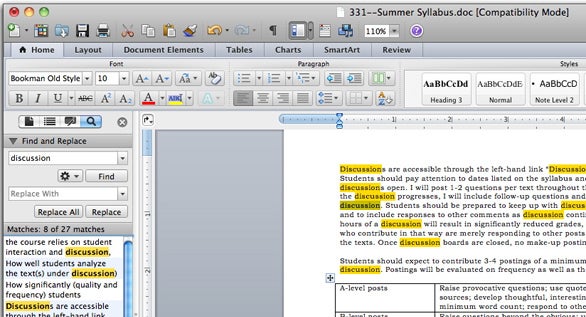
Firstly, select some text you want to ‘find and replace’ within. Then select Edit -> Find -> Advanced Find and Replace Great!
You’re now greeted by the find window. Here you’ll see that it says you’re going to search within the ‘current selection’, that’s good! It’ll look like this (I’m going to replace tab characters with a single space): Now here’s the unintuitive bit — click on the ‘replace’ tab. You’ll notice that there’s no mention that this will only apply to the current selection, but you’ll have to trust me.
Don’t press find next, or anything like that, click ‘replace all’, and it will do your find and replace in your current selection only (I promise!). Finally it will ask you if you want to do the rest of the document, simply click ‘no’ and you’re done.
Hope that helps someone, my wife and I found it very confusing. Bonus tip - How to find and replace tab characters: Check out my ‘replace’ dialog above, notice that I’m replacing a tab character? Well if you click the find box and press TAB it won’t enter the tab character, it will take you to the next box (oh no!).
The solution is to hold down ALT when you press tab, and it will insert the TAB character instead. One Last Thing If you find yourself spending hours formatting Microsoft Word documents, I can teach you to reduce that time to less than 5 minutes.
MathType 6.x (Windows) MathType 6.x (Macintosh) Microsoft Word 2002 and later (Win) Microsoft Word 2008 and 2011 (Macintosh) Does not apply to Word 2016/365 for Mac. Issue After opening a previously saved Word file containing MathType equations, you discover all or some of the MathType objects have become non-editable 'pictures.' This is associated with the Auto-recovery function in Word.
We know the bug is in Word, because the same issue happens with other embedded 'objects', such as Excel charts. Symptoms • Attempting to edit an equation by double-clicking on it will bring up the Format Picture dialog instead of MathType. • Copying and pasting the equation into a MathType window results in the error 'The Clipboard contains no equation data' Prevention Microsoft recommends turning off the Auto-save function in Word. Note however, this is a prevention step and will not repair equations that have already become non-editable pictures. The steps to disable auto-save are different for each version of Word whether on the Macintosh or on the Windows platforms.
Simply look for the 'Save' preferences for your version of Word and remove the check mark from 'Save Auto-recovery data every x minutes.' Solutions In many cases, the equations will display and print correctly. If you don't need to edit the equations, it is possible to simply leave them as they are. If you only need to edit a small number of equations, it may be more expedient to delete those equations and recreate them in MathType. It's rare, but in some cases it may be possible to recover the equations by running the Convert Equations command within Word: • Open the document in Word and save it as an RTF (Rich text format) document. • From the MathType menu (or Tab), choose Convert Equations.
• Choose the following settings in the Convert Equations dialog: Under 'Equation Types to Convert', select (as a minimum) 'MathType or Equation Editor Equations' and 'Microsoft Word EQ Fields'. Set the Range to 'Whole Document'. • Under 'Convert equations to' select 'MathType equations (OLE objects)'. • Click the 'Convert' button to start the conversion process. • When the conversion is complete, a dialog will appear confirming the number of equations converted. • Save the document from Word as either a.doc or.docx file. (When it comes to this issue,.doc seems to be more stable than.docx.) • The document and hopefully all equations might be editable now using any version of Word along with MathType.