Format Ntfs To Fat32 For Mac
PCMag reviews products, but we may earn affiliate commissions from buying links on this page. When you have a new hard drive, or when you're reinstalling Windows, the OS may ask you to format the drive.
The Data Analysis Toolpak was removed in Mac:Office for Mac 2008. Click Tools -> Select Add-Ins. Solver was added to Microsoft Office for Mac 2011 in Service Pack 1. Data analysis for excel on mac. You can download and install Office for Mac 2011’s Service Pack 1 by clicking on the link below: When you have installed Service Pack 1 (SP1), follow these steps to start Solver: a. Click to select the check box for Solver.Xlam.
Double click the USB flash drive to show its Properties and then click Policies tab. And then select Optimize for performance and click OK button (On Windows XP) If your computer runs Windows Vista / 7 or later version of Windows, it shows Better performance. Faststone image viewer for mac os x download windows 7. Right click the USB flash drive and then format it with NTFS file system.
If given a choice, the two common modes are NTFS and FAT32. But what are those, and why would you choose one over the other? We break down the differences between FAT32 vs. What They Mean FAT32 is the older of the two drive formats. FAT32 is the most common version of the FAT (File Allocation Table) file system created back in 1977 by Microsoft.
It eventually found its way on the IBM PC's PC-DOS in 1981, and carried over to MS-DOS when that became a standalone product. FAT had been the standard format for floppy disks and hard drives all through the DOS years, and versions of Windows up to and including Windows 8. NTFS (New Technology Files System) is the newer drive format. Microsoft introduced NTFS in 1993, as a component of the corporate-oriented Windows NT 3.1 and then Windows 2000, though it didn't become common on consumer PCs until Windows XP in 2001.
Windows 7 and 8 default to NTFS format on new PCs. Compatibility FAT32 is read/write compatible with a majority of recent and recently obsolete operating systems, including DOS, most flavors of Windows (up to and including 8), Mac OS X, and many flavors of UNIX-descended operating systems, including Linux and FreeBSD. NTFS, on the other hand, is fully read/write compatible with Windows from Windows NT 3.1 and Windows XP up to and including Windows 8.
Mac OS X 10.3 and beyond have NFTS read capabilities, but writing to a NTFS volume requires a third party software utility like Paragon NTFS for Mac. There are other hacks and workarounds for NTFS on the Mac, but in any case NTFS is only semi-compatible with OS X.
NTFS on Linux systems is spotty for both read and write operations. Look for NTFS-3G driver support on your Linux support page to see if it's built in. File Size Matters FAT32 file size support tops out at 4GB and volume size tops out at 2TB. This means that you're limited to 2TB FAT32 partitions if you want to use a 4TB drive.
It also means that you are limited to 4GB files. This is a concern with uncompressed high-definition movie files, where 30GB files are not unheard of. Theoretically, NTFS is limited by design to 16EB (Exabytes). One Exabyte is the equivalent of one billion Gigabytes, so we're quite a ways away from maxing out NTFS.
In practice, 2 to 4TB volumes are the limit at this time. Larger volumes will require a 64-bit OS and compatible hardware.
Which is Faster? While file transfer speed and maximum throughput is limited by the slowest link (usually the hard drive interface to the PC like SATA or a network interface like 3G WWAN), NTFS formatted hard drives have tested faster on benchmark tests than FAT32 formatted drives. Other factors will be in play, however, including drive technology (HDD vs. SDD, Flash vs. Non-Flash, etc.) and file fragmentation (on spinning drives).
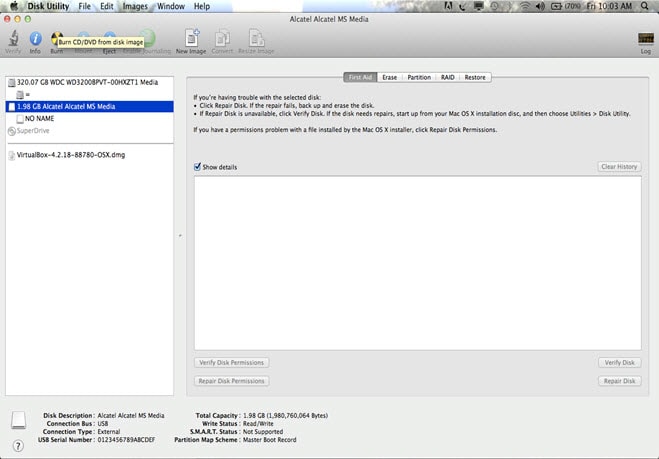
How to Check a Drive’s File System RELATED: So how do you know if your USB drive is? You don’t need to do anything special with Disk Utility–just plug in your USB drive and open the Finder. Right-click or Control-click the drive’s icon in the Finder’s sidebar (or on your desktop) and select “Get Info.” You’ll see the drive’s file system displayed to the right of “Format” under the General heading. In the screenshot below, the drive is formatted with the exFAT file system. How to Format a Drive on a Mac If you want to use a different file system on your USB drive, you’ll need to “format” it. Again, formatting a drive will erase it completely, so make sure you have everything backed up that you want to keep. To format a drive on a Mac, you’ll need the built-in Disk Utility application.